AICTE ATAL Sponsored Six Days Online Faculty Development Program

SRM Valliammai

Artificial Intelligence and Data Science

Artificial Intelligence and Data Science combine machine learning, deep learning, and statistics to build intelligent systems that learn from large datasets and support smart decisions in real-world applications.

About the Department

Department of Artificial Intelligence and Data Science

B . Tech in Artificial Intelligence and Data Science that is a blend of Artificial Intelligence and Data Science designed to develop a basic understanding of problem solving, knowledge representation, reasoning and learning methods o f AI. This course enables the students to develop their skillset to do intelligent data analysis which is a key component in the emerging Data Science careers in IT field. AI technology enables software, apps, and machines to learn, think, and correct them selves the same way humans do. A large part of AI involves machine learning, which allows computers to understand and copy human behaviour by finding data patterns. Machine learning is the link that connects Data Science and AI. AI is the tool that helps data science get results and the solutions for specific problems.

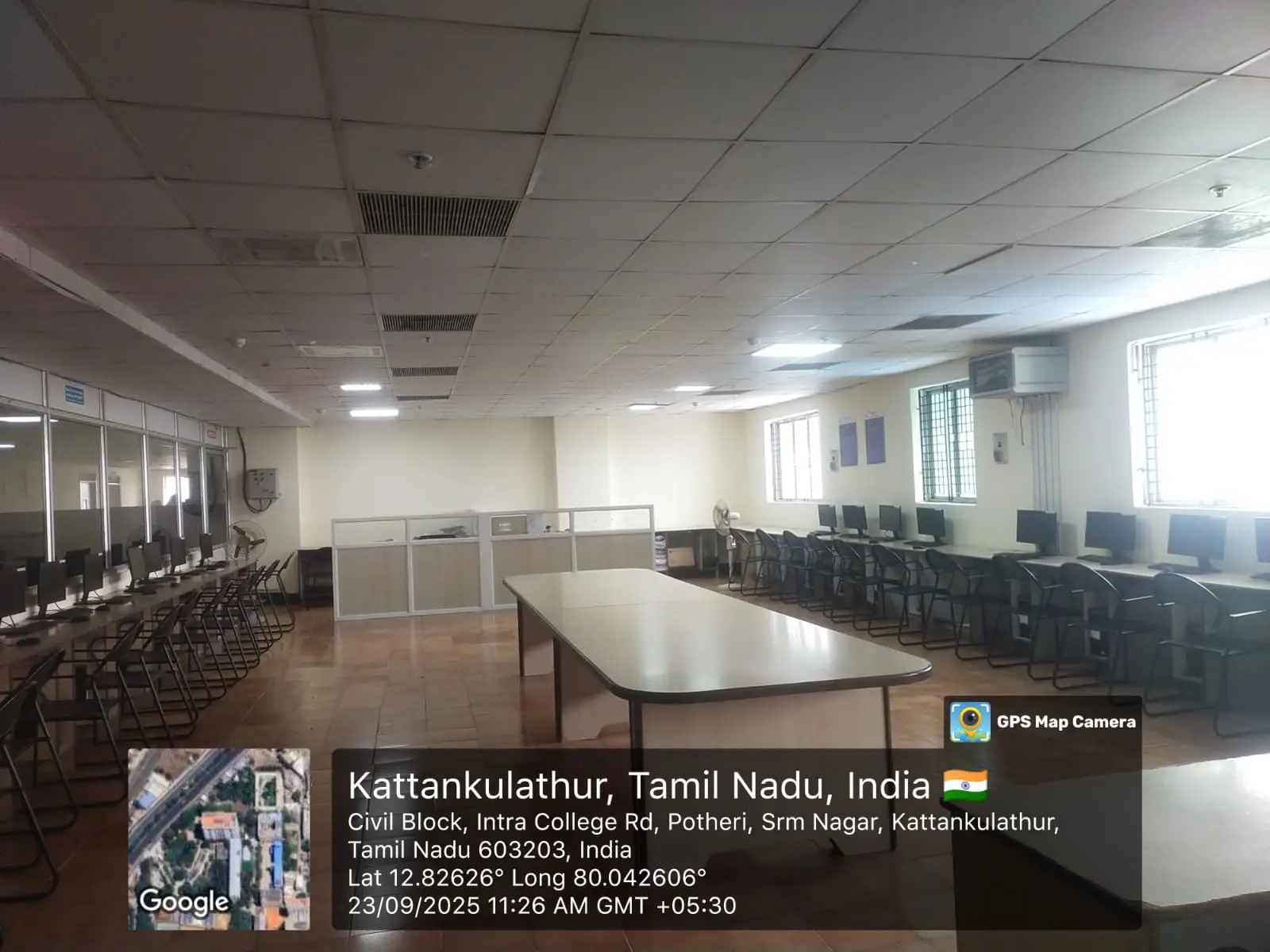
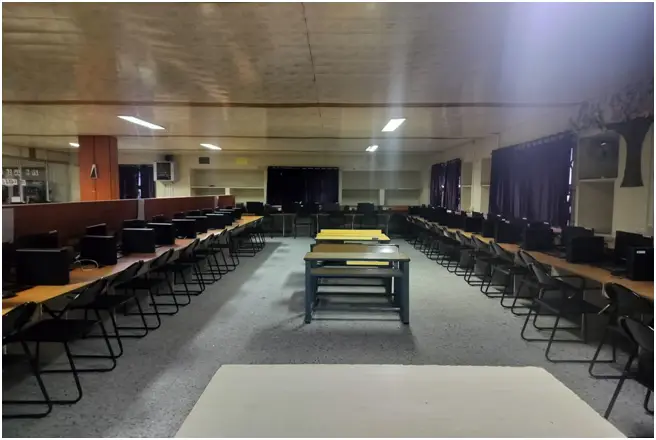
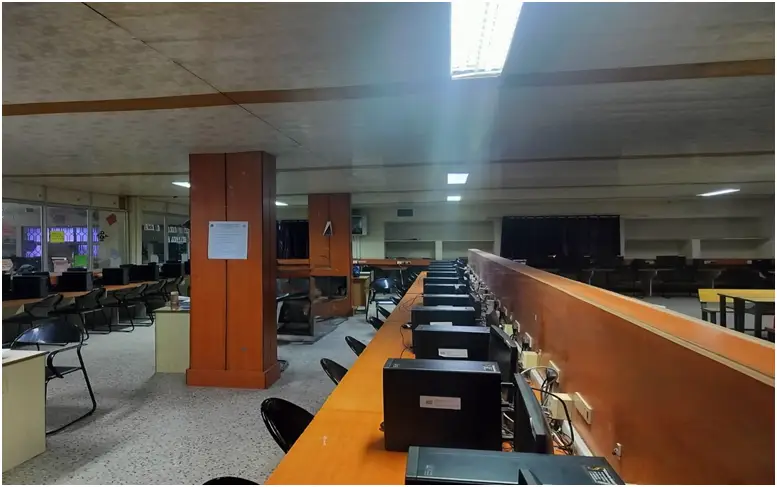
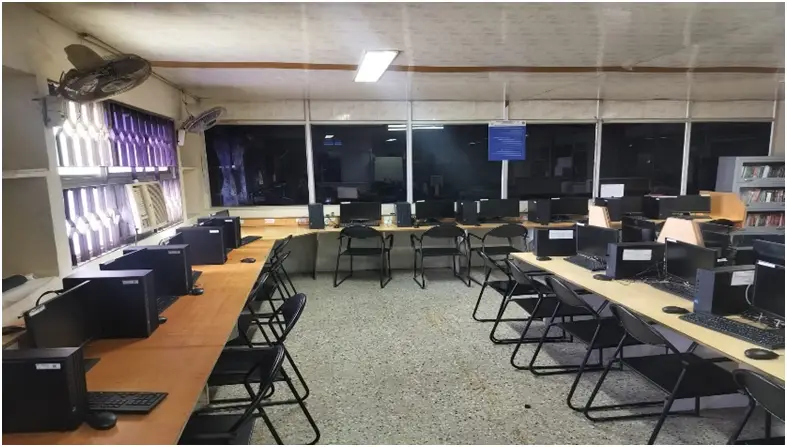
Two numbers of well – equipped Hi – tech laboratories with 60 high end machines with internet connection, Well – structured class rooms and laboratories are provided to the students to carry out the experiments. The department has started with the intake of the 60 students in the year 2020-21. The intake has been increased to 120 in the year 2024-25. A highly qualified team of 12 Faculty members including 2 Doctorate and the Research Expertise in the areas of specialization are disseminated in the department to guide the students to excel in their academic.

The Department adheres the Objective of the Institution to promote the development and growth of True, Effective and Efficient ‘Engineering Professionals’, through adherence to the highest Standards of Academic Integrity and overall Ethical conduct, to inculcate sense of Individual responsibility and also to collectively participate in reinforcing and maintaining an Environment of ‘Honor, Trust and Standards’.

Vision & Mission
Vision

To develop an excellent progressive quality education, translational research through inventive collaborations as per industry requirements to improve the healthcare and well-being of humankind

Mission

M1: To Acquaint students with the current technology to provide consultations and technical support to hospitals, healthcare and service sectors.

M2: To educate students with the fundamental knowledge, interdisciplinary problem solving skills and confidence required to excel in medical electronics through progressive learning.

M3: To propagate creativity, responsibility, commitment and leadership qualities and exhibit professional ethics and values.

Programme Overviews

PEO1: To prepare our students for successful placement and career in industries, besides, pursuing higher studies.

PEO2: To prepare students to succeed in employment/profession and/or to pursue post graduate and research educations in Electronics and Communication Engineering discipline in particular and allied engineering disciplines in general.

PEO3:To prepare students with engineering breadth to innovate, design, develop electronics products and to contribute in providing solutions related to multidisciplinary real life problems.

PEO4: To inculcate in students professional and ethical attitude, effective communication skills and teamwork to become a successful professional.

PEO5: To provide students with an academic environment that makes them aware of excellence and life-long learning in emerging technologies.


PO# Graduate Attributes Programme Outcomes
1 Engineering Knowledge Apply knowledge of mathematics, science, engineering fundamentals and engineering specialization to the solution of complex engineering problems.
2 Problem Analysis Identify, formulate, research literature and analyze complex engineering problems reaching substantiated conclusions using modern tools and techniques.
3 Design/Development of Solutions Design solutions for complex engineering problems and design systems, components or processes that meet specified needs with appropriate consideration for public health and safety, and cultural, societal, and environmental considerations.
4 Investigation of Complex Problems Conduct investigations of complex problems, including design and execution of experiments, analysis and interpretation of data, and synthesis of information to draw valid conclusions.
5 Modern Tool Usage Create, select and apply appropriate techniques, resources, and modern engineering and IT tools including prediction and modeling to complex engineering activities with an understanding of the limitations.
6 The Engineer and Society Apply reasoning informed by the contextual knowledge to assess societal, health, safety, legal and cultural issues and the consequent responsibilities relevant to professional engineering practice.
7 Environment and Sustainability Understand the impact of professional engineering solutions in societal and environmental contexts and demonstrate knowledge of and need for sustainable development.
8 Ethics Apply ethical principles, commit to professional ethics and responsibilities and norms of engineering practice.
9 Individual and Team Work Function effectively as an individual, and as a member or leader in diverse teams and in multidisciplinary settings.
10 Communication Communicate effectively on complex engineering activities with the engineering community and with society at large, such as being able to comprehend and write effective reports and design documentation, make effective presentations, and give and receive clear instructions.
11 Project Management and Finance Demonstrate knowledge and understanding of engineering and management principles and apply these to one’s own work, as a member and leader in a team, to manage projects and in multidisciplinary environments.
12 Life-long Learning Recognize the need for and have the preparation and ability to engage in independent and life-long learning in the broadest context of technological change.

PSO1:Ability to apply the acquired knowledge of basic skills, mathematical foundations, principles of electronics, Modeling and design of electronics-based systems in solving engineering Problems in healthcare.

PSO2: Ability to use the advanced technology for measurement and develop innovative sustained solutions in health care.

PSO3: Ability to examine indigenous clinical gadgets through the application of their core area ideas and emerging ICTs.

PSO4: Ability to perform effectively as a part of a team with professional behavior and ethics to achieve a successful career.

Apply Now For Academic Year 2026-27

Apply Now

Industry Interaction

Company Name Date Domain of Company Coordinator Resource Person
LABORATORY

The Department have well equipped laboratories with more than 120 computers with various software and equipment’s relevant for the industry. The following are the 6 laboratories associated with the department.

Computer 30
Printer 2
UPS APC Online 10 KVA UPS
Software Anaconda, R-Studio, Pyhton, Adobe DreamWeaver, XAMPP, SwiProlog
Computer 30
Printer 1
Scanner 1
UPS APC Online 10 KVA UPS
Software Anaconda, R-Studio, Python, Blender, Jupiter Notebook, Tutbo C, SQLite
Computer 30
Printer 1
UPS APC Online 10 KVA UPS
Software Anaconda, R-Studio, Python, Blender, Jupiter Notebook, Tutbo C, SQLite
Computer 30
System Configuration Intel Core i7 13TH GEN
16GB RAM
1 TB HDD & 512 SSD – 20 Nos.
Intel Core i7 13TH GEN, INTEL 6GB ARC GRAPHICS CARD
16GB RAM
1 TB HDD & 512 SSD – 10 Nos.
UPS APC Online 10 KVA UPS
Software Anaconda, R-Studio, Python, Blender, Jupiter Notebook, Tutbo C, SQLite

List of Laboratories :

  • Python Programming Lab
  • C Programming Lab
  • Computational Intelligence Essentials Lab
  • Programming and Data Structures Lab
  • Data Science and R Essentials Lab
  • DBMS and Mining Lab

Library

Department of AI&DS Library Book Details
S.No Department Library Books No. Of Project Reports
1 50 -
Central Library details
S.No Department No. Of Titles No. Of Volumes No. Of National Journals No. Of International Journals No. Of E-Journals
1 AI&DS 10 36 6 6 232
Central Library E-Journal Details
S.No Department IEEE Elsevier J-GATE (E&T) NTotal
1 AI&DS 4 8 220 232
Placement

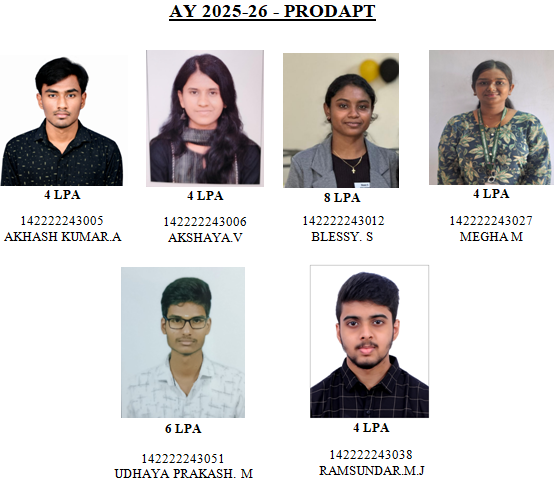
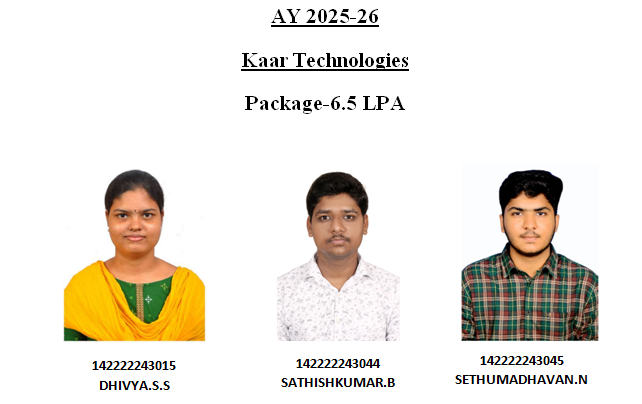
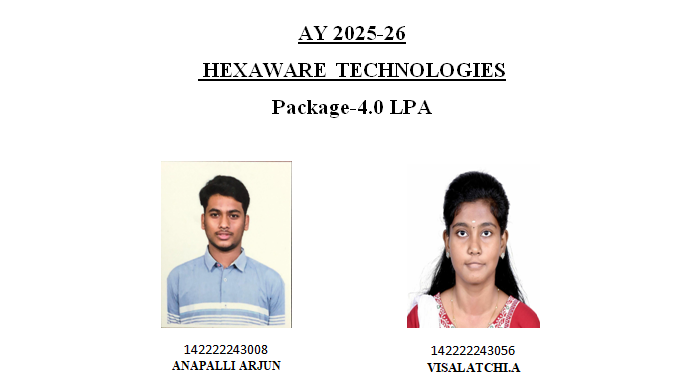
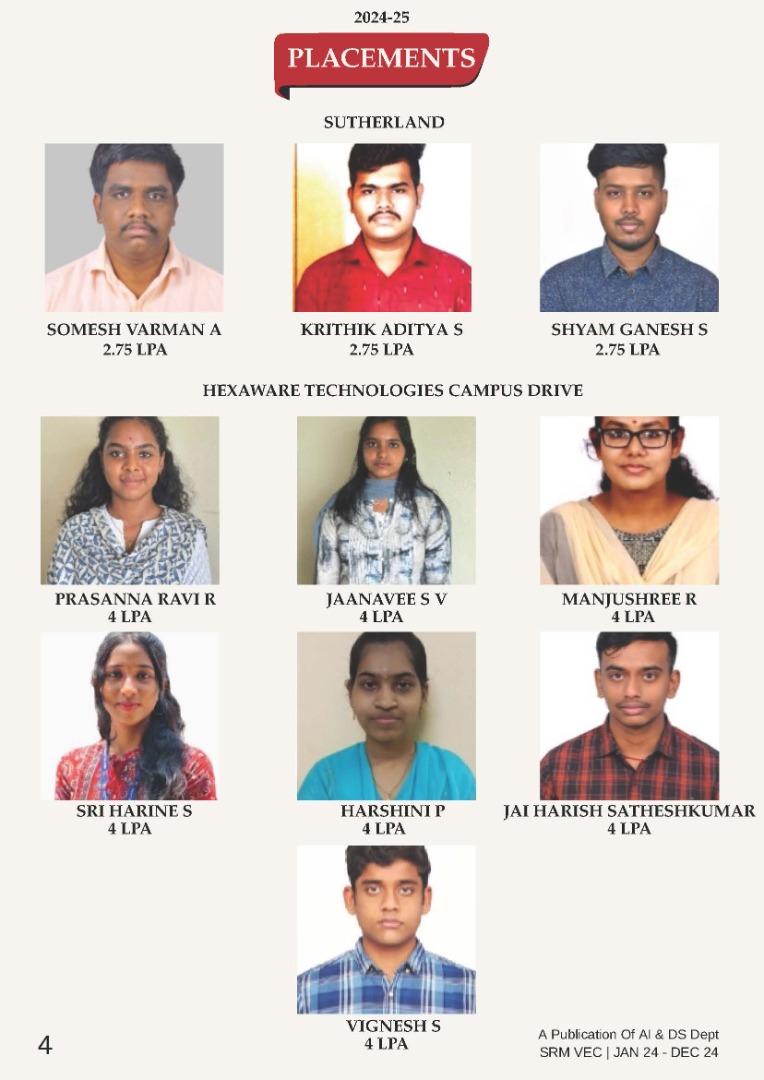
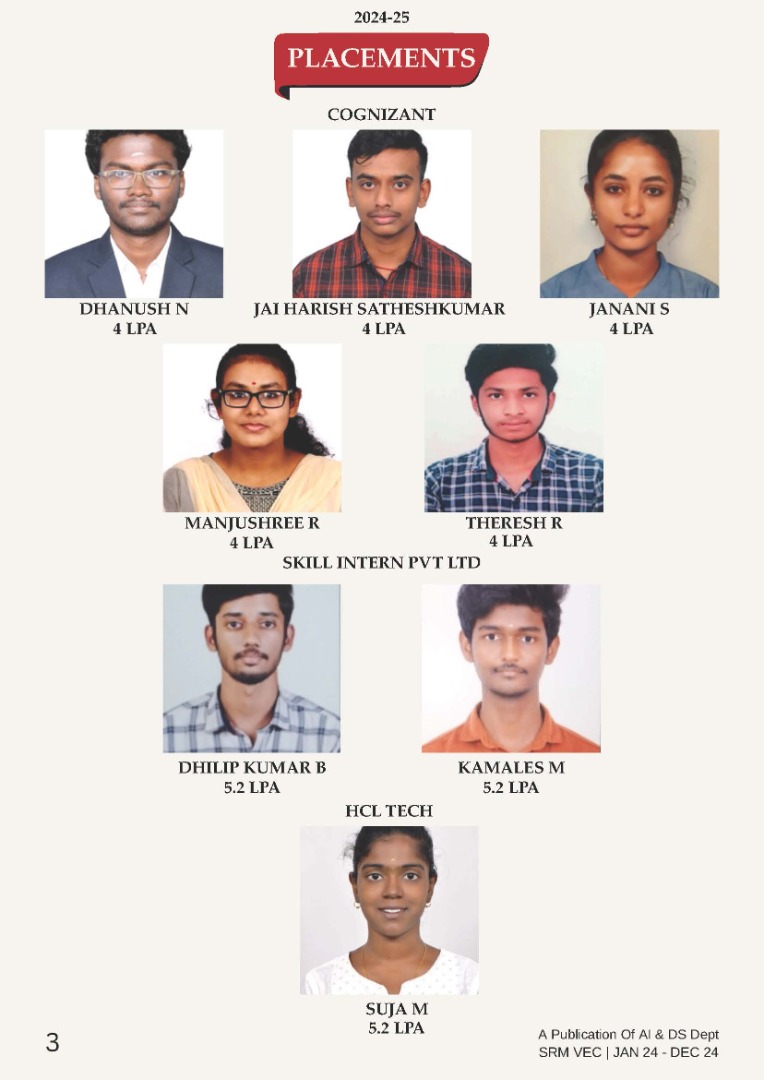
The Department of Placement and Career Guidance shoulders the responsibility of training the students and placing them in esteemed companies. The department meticulously works in networking with the companies and HRs of varied fields and schedules campus drives accordingly. Placement Department is fully involved in developing the students by constantly monitoring the dynamic changes in the requirements of various fields and accordingly address the needs of the students by training and updating them. They are involved in creating awareness among the students on the requirements of Industries. and preparing the students to suit the demand of the Industries. They play a major role in Imparting Soft Skills through training.

Placement Records

Details of Placement- 2020-25 Batch:

S.No Company No. Of Students Placed
1 KAAR TECHNOLOGIES 2
2 HEXAWARE TECHNOLOGIES 1
3 TATA ELXSI 1
4 PEOPLEINK 8
5 AVASOFT 1
6 TELLIANT SYSTEMS 2
7 SUTHERLAND 5
8 iTECH 2
9 SYSTEM SOLUTIONS Pvt. Ltd 1
10 UST GLOBAL 1
11 DELOITTE USI CONSULTING 2
12 TURNING POINT 1
13 INTELLIPAAT 2
14 COGNIZANT 2
15 TCS 5
16 STATS PERFORM 2
17 QSPIDERS 12
Total Placed Students 33
Alumni
Research
MOU's
Contact
Dr. B. Muthusenthil B.E, M.E, Ph.D., Post Doc (South Korea)

Professor & Head i/c,
Dept. of Artificial Intelligence and Data Science,
SRM Valliammai Engineering College,
SRM Nagar, Kattankulathur – 603 203,
Chengalpattu District,
Tamil Nadu, India.

Contact Details

Mobile: +91 – 94440 50687

Tel: 044 – 27454784 / 726
EXTN : 8261

Fax: 044 – 2745 1504

Email: hod.ai-ds@srmvalliammai.ac.in

Facilities

Library
Canteen
Banks
Scholarships
Transports
Medical Facilities
ISO